

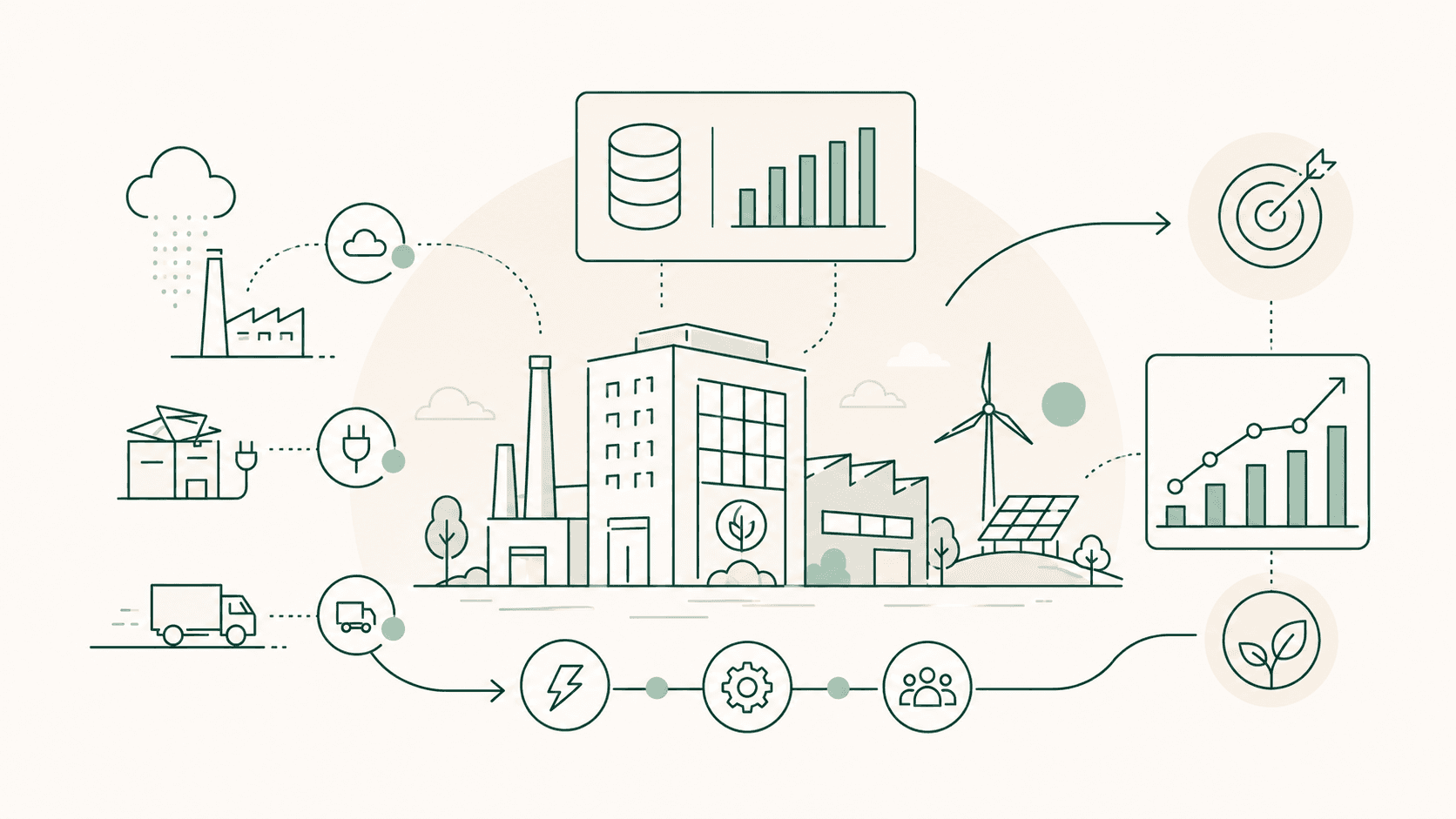
Corporate decarbonization requires companies to turn emissions data into operational decisions: understand where emissions are concentrated, identify the actions with the greatest reduction potential and measure their results over time. This article explains how to build a decarbonization plan, reduce the corporate carbon footprint and apply practical strategies across Scope 1, 2 and 3 emissions.
What is corporate decarbonization?
Decarbonization is the process through which a company progressively reduces its greenhouse gas emissions by acting on the activities that generate them. Depending on the company’s emissions profile, this may involve energy consumption, production processes, transportation, materials, products and the value chain.
For the process to be manageable, it must start from a quantitative baseline. A corporate carbon footprint makes it possible to establish the starting level of emissions and identify the sources that contribute most to the total. This provides the evidence needed to figure out where the carbon footprint is concentrated and which reduction actions can generate the greatest impact.
Measurement therefore has a clear decision-making function: it helps prevent capital and resources from being directed toward initiatives with only a marginal impact on overall emissions. Companies that want to reduce their carbon footprint need to move beyond the total emissions figure and understand the contribution of individual sites, processes and value-chain activities.
The decarbonization process varies according to the sector and the company’s emissions profile. In industrial decarbonization, for example, a significant share of the reduction potential may lie in energy use and production processes. Companies with extensive value chains may instead find their main opportunities in procurement, materials and supplier management.
Corporate decarbonization contributes to the broader reduction of emissions across economic sectors. At company level, however, the priority is to translate this objective into actions that are compatible with available technologies, investment capacity and operational requirements.
The distinction between Scope 1, Scope 2 and Scope 3 helps companies understand where emissions occur and how much control the organization has over each source. Building a consistent GHG inventory also requires clear rules for organizational boundaries, calculation and reporting. International references such as the GHG Protocol and ISO 14064 provide the methodological foundation for structuring traceable and verifiable emissions data.
How to build a decarbonization plan
A decarbonization plan translates the emissions baseline into actions, responsibilities, timelines and expected results. The first step is to identify the sources that contribute most to the company’s carbon footprint and assess how much influence the organization can realistically exercise over them.

The GHG Protocol Corporate Standard provides a widely used methodological framework for building a corporate GHG inventory. A structured and consistent baseline allows companies to compare emission sources, estimate their carbon footprint with greater consistency and base subsequent reduction decisions on reliable data.
The size of an emission source does not determine its priority on its own. When comparing potential initiatives, companies should consider the expected reduction in tonnes of CO₂e, required investment, implementation time, technical feasibility and any dependence on suppliers or other external parties. Where sufficient data is available, the cost per tonne of CO₂e avoided provides an additional metric for comparing very different initiatives.
This approach helps distinguish actions that can be implemented quickly from those requiring structural change. Optimizing an existing system may deliver relatively fast reductions with limited investment, while replacing a production technology may offer greater long-term potential but require capital expenditure, engineering work and longer implementation times. Both can belong in the same plan, with different timelines and expected contributions.
Once actions have been selected, each initiative should have at least a baseline, an expected reduction, a deadline and a responsible owner. If a project is expected to reduce natural gas consumption at a facility by 500 tCO₂e per year, the plan should make it possible to verify whether that reduction was achieved and how much it contributed to the overall target.
The same logic applies to indirect emissions, although the company becomes more dependent on data quality and its ability to influence external parties. A mature plan therefore combines actions under direct operational control with medium-term initiatives across the value chain, rather than concentrating exclusively on the areas that are easiest to measure.
What software is needed to build a credible decarbonization plan?
To build a credible decarbonization plan, software should allow companies to connect emissions measurement with targets and reduction initiatives. A carbon footprinting tool becomes useful when it goes beyond calculation and helps the company structure the baseline, assess reduction priorities and monitor progress over time.
The most useful decarbonization software solutions allow companies to manage the emissions baseline, Scope 1, 2 and 3 emissions, reduction targets, decarbonization projects and progress KPIs within the same environment. Each initiative should be linked, where possible, to an expected reduction in tCO₂e, a timeline, an owner and the associated investment. This makes it possible to compare the planned initiatives against the company’s reduction pathway and update the plan when actual results differ from expectations.
Data quality and traceability are equally important. A plan that combines information from multiple sites, functions and suppliers should preserve the sources, calculation methodologies and baseline updates behind the figures. This allows the company to determine whether a change in emissions is genuinely attributable to a reduction initiative or instead results from changes in production volumes, organizational boundaries or data quality.
Among the platforms designed to support this type of management, Metrikflow connects carbon footprint measurement with the definition and monitoring of emissions reduction initiatives. For companies, the value of this approach lies in the ability to measure emissions, identify priorities and track the progress of the decarbonization plan using the same data foundation, reducing fragmentation across spreadsheets, business systems and individual project documentation.
Strategies to reduce Scope 1, 2 and 3 emissions
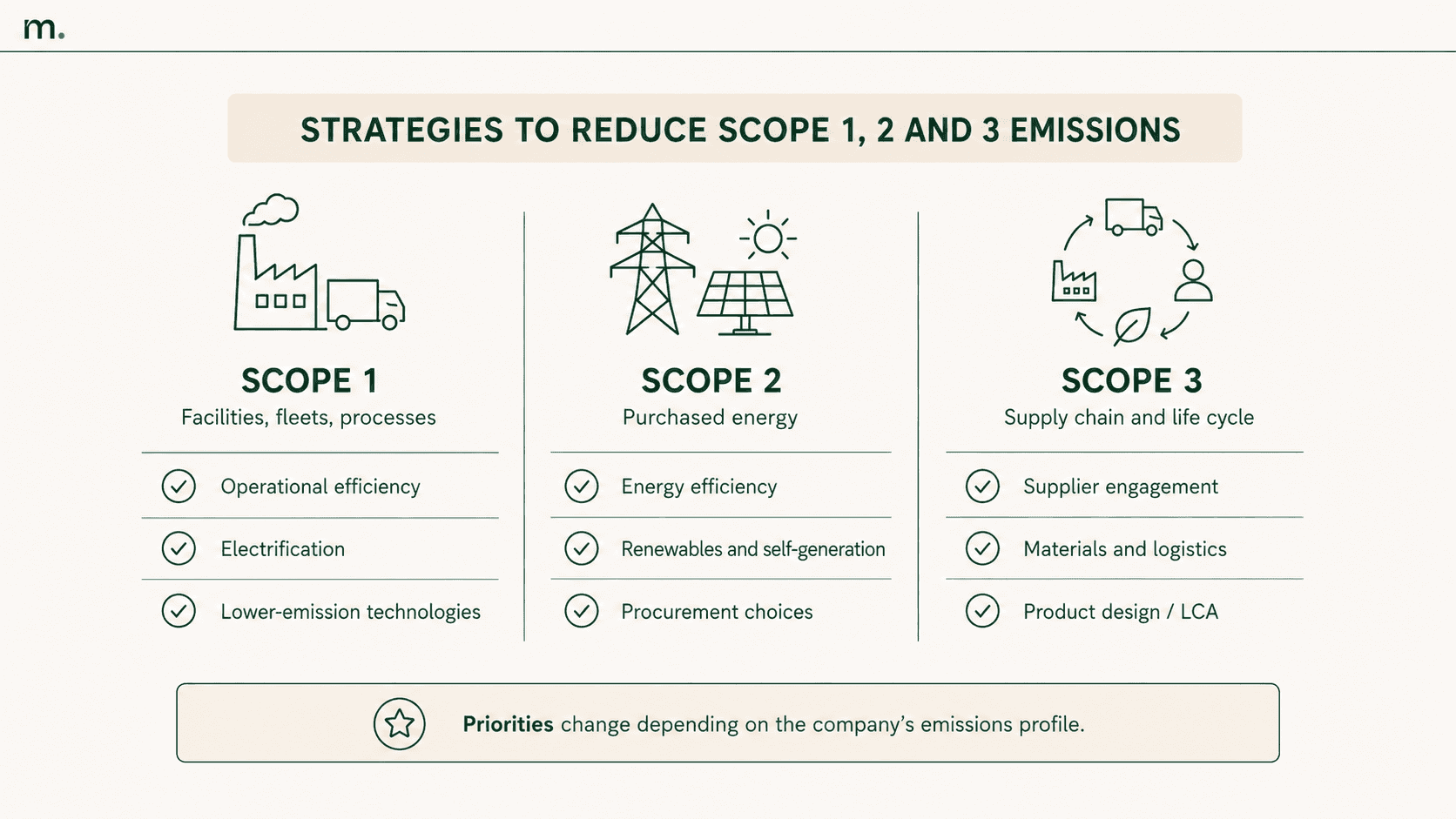
Decarbonization strategies depend on the emissions source and the level of control the company has over it. Separating Scope 1, Scope 2 and Scope 3 helps companies match each emissions category with appropriate reduction levers and assess initiatives as part of the overall carbon footprint.
How to reduce Scope 1 emissions
Scope 1 emissions come from sources owned or controlled directly by the company, including fuels used in facilities, company-owned vehicles and certain industrial processes. Reduction often begins with improving the efficiency of existing operations. Process optimization, leakage reduction, equipment maintenance and lower fuel consumption can generate measurable results without immediately replacing existing infrastructure.
Once incremental efficiency improvements reach their limits, the plan may require more structural interventions. Process electrification, equipment replacement and lower-emission production technologies can significantly reduce direct fossil fuel consumption, but they require a specific technical and financial assessment.
Electrification illustrates why the three scopes need to be managed together. Replacing a gas-powered process with an electric alternative reduces direct emissions but increases purchased electricity demand. The overall emissions outcome therefore also depends on the emissions intensity of the electricity used and the resulting impact on Scope 2.
In sectors where some process emissions remain technically difficult to eliminate, planning needs to account for longer technology and asset replacement cycles. Industrial feasibility and asset renewal schedules can therefore become important constraints when defining the reduction pathway.
How to reduce Scope 2 emissions
Scope 2 covers emissions associated with purchased energy. The main reduction levers act on two variables: how much energy the company consumes and the emissions intensity of the energy it purchases.
Reducing demand through energy efficiency can lower both emissions and operating costs. Initiatives may involve buildings, heating and cooling systems, lighting, motors, production lines and energy management systems, but priority should reflect actual consumption and the expected return of each intervention.
The second lever is energy sourcing. On-site renewable generation and electricity procurement arrangements can change the emissions profile of purchased electricity. The appropriate option depends on the company’s energy demand, site locations, available space and infrastructure, contract duration and commercial conditions.
The interaction between efficiency, electrification and procurement is especially relevant for industrial companies. Energy consumption can increase while total emissions decrease if more processes are electrified and the electricity used has a lower emissions intensity. The plan therefore needs to evaluate the combined effect of individual initiatives rather than assessing them in isolation.
How to reduce Scope 3 emissions
Scope 3 emissions arise across the supply chain and the wider value chain. They can include purchased goods and materials, transportation, supplier operations, product use and end-of-life treatment, and therefore require a different approach from emissions generated by sources under the company’s direct control.
The first criterion is category relevance. If purchased goods and services account for a significant share of emissions, priorities may include improving supplier data, comparing alternative materials and incorporating climate criteria into procurement decisions. Where transport and distribution are more significant, interventions may focus on transport modes, load utilization, distances and logistics planning.
Supplier engagement becomes more effective when it is concentrated on areas capable of changing the result. Requesting the same level of information from thousands of suppliers can create substantial workload without producing equivalent decision value. Segmenting suppliers by emissions contribution and relevance allows companies to focus higher-quality data collection where it matters most.
For companies that manufacture products, part of the reduction potential may lie in design decisions. Material choice, weight, durability, energy consumption during use and end-of-life treatment all influence emissions across the product life cycle. A Life Cycle Assessment can support comparisons between alternatives and help prevent an improvement in one life-cycle stage from simply shifting environmental impacts to another.
Decarbonization targets: SBTi and Net Zero
The operational plan needs to be linked to a defined timeline. A decarbonization target establishes how much the company intends to reduce emissions from its baseline and by when, creating a reference point against which planned actions can be assessed.
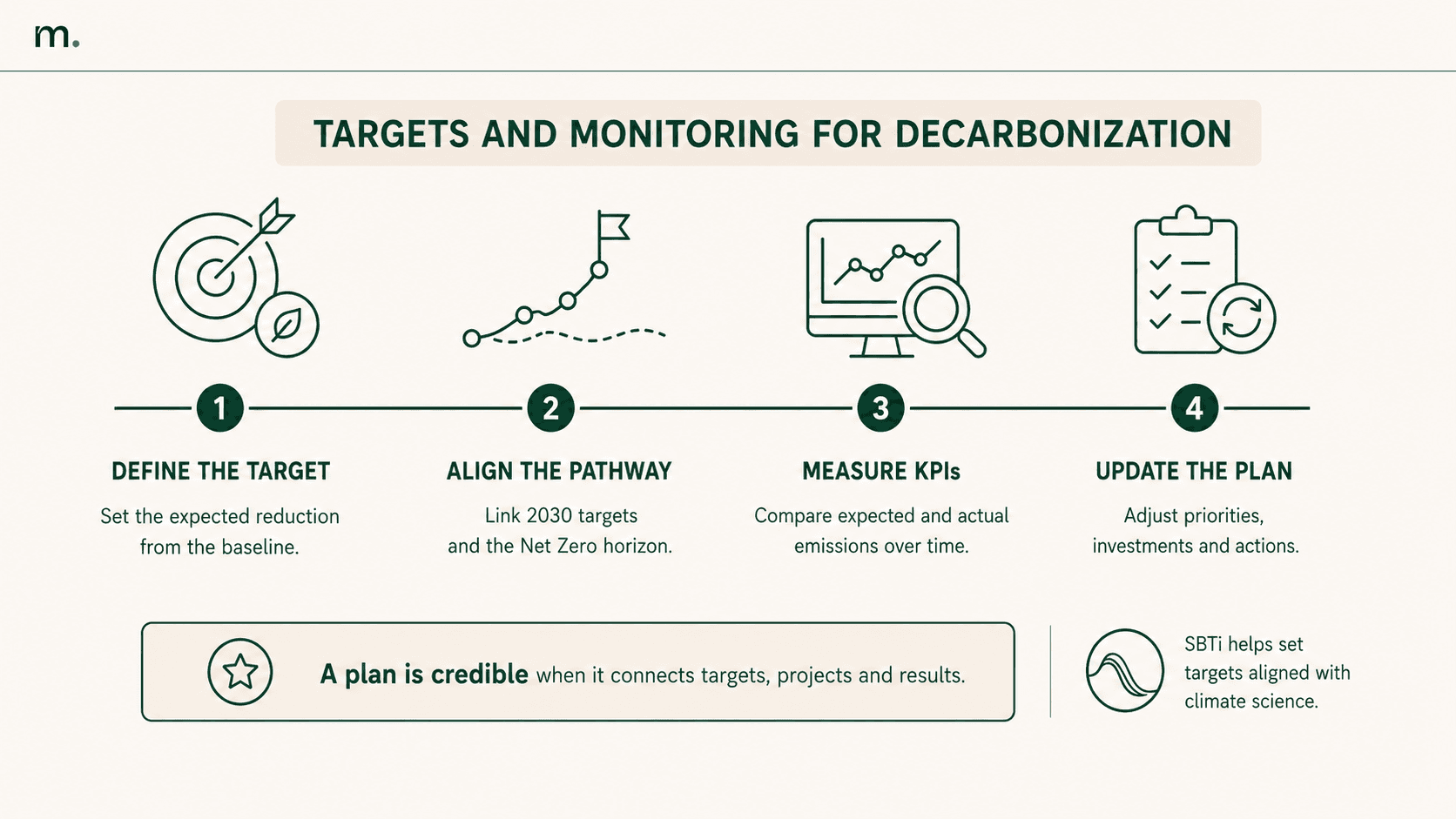
Interim targets are particularly useful for business management because they make it possible to measure progress before the final deadline. A 2030 target, for example, can be translated into annual or multi-year milestones and compared with the actual emissions trajectory.
The SBTi framework provides criteria and methodologies for setting emissions reduction targets aligned with climate science and with pathways consistent with the goals of the Paris Agreement. The official SBTi Corporate Net-Zero Standard provides the reference framework for corporate Net Zero targets and connects near-term and long-term targets to a measurable reduction pathway.
Net Zero represents a long-term destination, generally no later than 2050 under the SBTi framework, and requires deep emissions reductions across the value chain together with specific treatment of residual emissions. A long-term date becomes operationally useful when it is translated into intermediate results, investments and clear responsibilities.
For the company, the most useful measure is the gap between current emissions and the required trajectory. That gap determines the pace of reduction initiatives and the level of resources required.
A target is credible when the portfolio of initiatives can explain how the company intends to achieve it. If the expected reductions from approved projects cover only part of the required outcome, the decarbonization plan makes the remaining gap visible and allows additional measures to be identified early.
How to monitor decarbonization progress
Monitoring determines whether reduction initiatives are delivering the expected results. The carbon footprint should therefore be updated using a sufficiently consistent methodology over time, distinguishing changes generated by reduction measures from those caused by business growth, acquisitions, boundary changes or fluctuations in production volumes.
Alongside absolute emissions, selected operational KPIs can help explain why performance is changing. Energy consumption per unit produced, renewable energy share, emissions per tonne of material purchased or the percentage of suppliers covered by primary data can show whether individual reduction levers are progressing as expected.
Comparing expected and actual results makes it possible to update the plan. A project delivering lower reductions than forecast may require corrective action, while an initiative outperforming initial estimates may change subsequent investment priorities. The decarbonization plan therefore becomes a recurring management tool for both investment decisions and emissions performance.
When data and responsibilities are spread across multiple sites, departments and suppliers, centralizing information makes it easier to compare the baseline, targets and actual results on a consistent basis. The same system used to build the plan can then support its ongoing revision, keeping deviations and outstanding priorities visible.
For a company, the effectiveness of a decarbonization strategy is ultimately measured by its ability to reduce emissions from a defined baseline while keeping investment, timing and technical feasibility under control. A credible plan makes these variables visible and allows management to decide where to act, in what order and with what expected result.
CONTRIBUTOR
Luis Antezana
Sustainability Analyst
Formed as a Chemical Engineer and with a focus on the energy sector, Luis applies a rigorous technical and analytical approach to decarbonisation and emissions measurement. Born in Bolivia and professionally developed across the United States and Europe, he contributes to the design and implementation of Carbon Footprint and Life Cycle Assessment (LCA) methodologies, helping organisations accurately quantify emissions while identifying opportunities to optimise processes, improve resource efficiency, and reduce operational costs. Luis approaches sustainability not only as a compliance exercise, but as a driver of measurable business value—linking environmental performance with economic returns, risk reduction, and long-term competitiveness.He works to make sustainability practical, data-driven, and financially meaningful for organisations and their stakeholders. Topics covered: Decarbonisation, Corporate Carbon Footprint, Life Cycle Assessment (LCA), Scope 1–2–3 accounting, GHG Protocol, Product Carbon Footprint (PCF).
Stay up to date with Metrikflow Insights!
We deliver expert insights, product updates, industry trends, and actionable strategies straight to your inbox. Stay ahead in ESG, GHG, and LCA — one edition at a time.
By submitting this form, you consent to receive the requested resource. For more information on how we process and protect your data, view our Privacy Policy.


